LED Dropping Resistor Calculator
This LED Dropping Resistor Calculator helps you choose the correct resistor for LEDs. Every LED must have a way to limit current. Without a resistor, an LED can fail almost instantly.
Use this free calculator to find the correct resistor value and power rating for one LED or multiple LEDs connected in series.
Why Do LEDs Need a Resistor?
LEDs do not limit their own current. When connected directly to a power source, too much current can flow. This causes the LED to overheat and burn out.
A dropping resistor limits current to a safe level. This protects the LED and helps it last much longer.
How to Use the LED Resistor Calculator
- Enter your power supply voltage
- Enter the LED voltage drop
- Enter the desired LED current
- If using more than one LED, enter how many are in series
The calculator will show the required resistor value, the nearest standard value, and the minimum resistor wattage.
Single LED vs Multiple LEDs in Series
A single LED needs a resistor to drop excess voltage. When LEDs are connected in series, their voltage drops are added together.
Series wiring is more efficient and helps keep LED brightness even. This calculator supports both single LED and series LED circuits.
Common LED Voltage and Current Values
| LED Color | Typical Voltage | Typical Current |
|---|---|---|
| Red | 1.8–2.2 V | 10–20 mA |
| Green | 2.0–3.0 V | 10–20 mA |
| Blue | 3.0–3.4 V | 10–20 mA |
| White | 3.0–3.4 V | 10–20 mA |
Always check the LED datasheet for exact values.
Choosing the Correct Resistor Wattage
Resistors convert extra electrical energy into heat. If the resistor is too small, it may overheat and fail.
Always choose a resistor with a higher power rating than the calculated value. Using a 1/4W or 1/2W resistor is common and safe.
Using LEDs with Arduino and 12V Power
Arduino boards usually provide 5 volts. Most LEDs need a resistor when used with Arduino pins.
Automotive and 12‑volt systems do not stay at 12 volts. They often reach 14 volts while operating.
Always enter the higher voltage into the calculator for safety.
Common LED Wiring Mistakes
- Connecting LEDs without a resistor
- Using the wrong voltage value
- Ignoring resistor wattage
- Wiring LEDs in parallel without proper current control
Example LED Resistor Calculation
Power supply: 5 volts
LED voltage: 2 volts
LED current: 20 mA
The calculator shows a resistor value of 150 ohms. A 1/4 watt resistor is safe and recommended.
Helpful Tools and References
Frequently Asked Questions
Can I run an LED without a resistor?
No. LEDs must be current‑limited to avoid damage.
What resistor should I use for a 5V Arduino?
Most standard LEDs work well with 220Ω to 330Ω resistors at 5V.
Why does my resistor get hot?
The resistor is dissipating excess power. Use a higher wattage resistor.
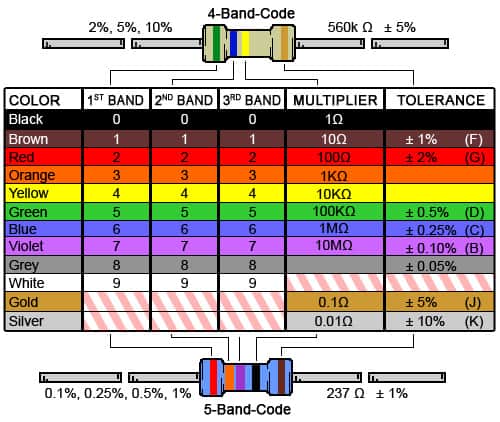
Resistor Color Band Identification